

Four weeks ago, CMS released a 173-page document that immediately started circulating in ABA leadership inboxes, compliance threads, and industry newsletters. The headlines ranged from measured to alarming. If you lead an ABA clinic and you’re still not sure what to make of it, here is the straightforward version.
What the CMS ABA Toolkit Actually Is
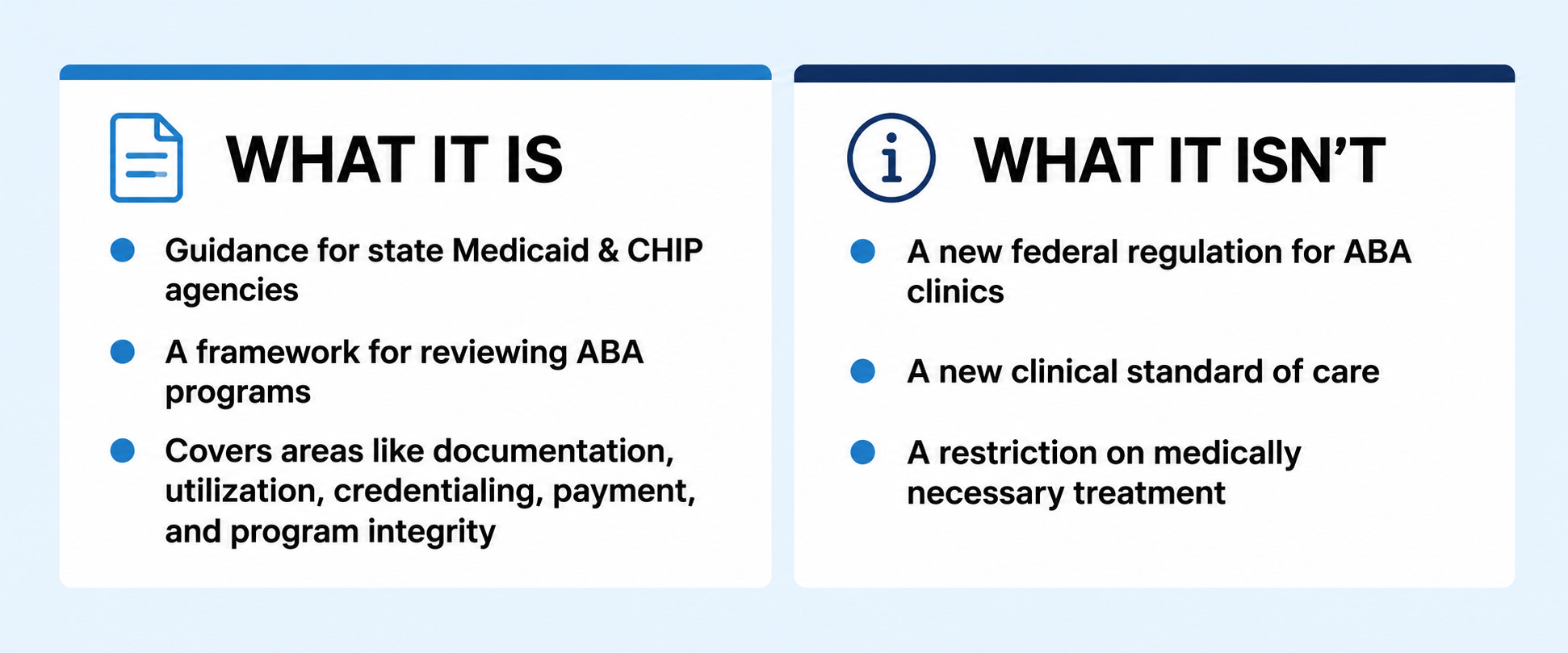
On August 4, 2026, the Centers for Medicare and Medicaid Services released the State Medicaid and Children’s Health Insurance Program Applied Behavior Analysis Toolkit a guidance document written for state Medicaid and CHIP agencies, not for ABA providers directly.
CMS was transparent about the reason it exists. Between 2021 and 2025, Medicaid and CHIP spending on ABA services grew 421% (from $1.94 billion to $10.1 billion) while the number of children receiving ABA grew 189% and the number of Medicaid and CHIP beneficiaries with an ASD diagnosis receiving services grew 67% (CMS, 2026). That spending disparity, alongside a documented pattern of fraud investigations and audit findings, prompted CMS to give states a structured framework for evaluating their own ABA programs.
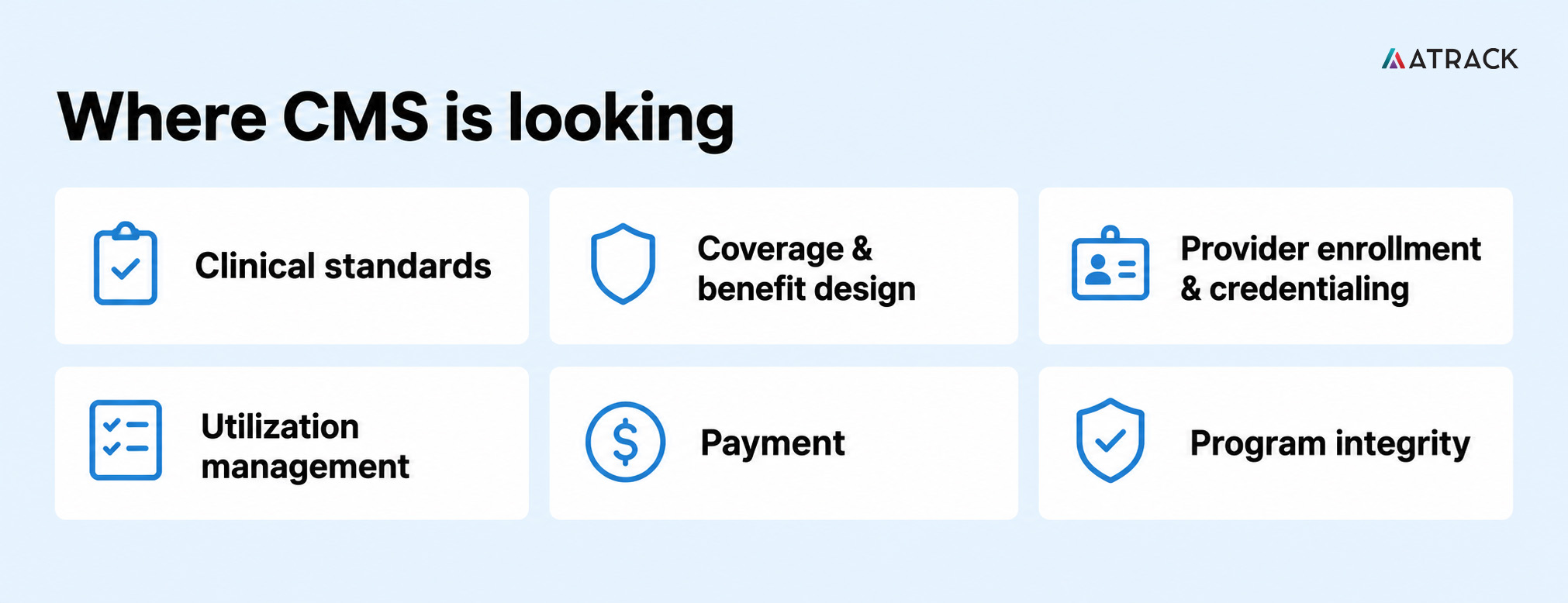
The toolkit covers six broad areas states may examine: clinical standards, benefit design, provider enrollment and credentialing, utilization management, payment methodology, and program integrity.
What It Does Not Mean for ABA Providers
This is the part most worth reading carefully because some of the coverage has not been.
CMS states explicitly in the toolkit that it does not create new federal provider requirements. It does not reduce Early and Periodic Screening, Diagnostic and Treatment (EPSDT) obligations. It does not restrict medically necessary care. It does not endorse any single treatment approach to ABA, and it does not direct states to limit access to services.
The toolkit is guidance to state agencies — not a mandate, not a regulation, and not an immediate change to what any provider is required to do today. States are encouraged to use it as a decision-making resource, with CMS acknowledging that approaches will vary based on each state’s program structure, population, and priorities.
Not every state will act on this toolkit. Not every state that does will act quickly. And the areas states may emphasize will differ.
What Clinic Leaders May Want to Pay Attention To
That said, the toolkit does not exist in isolation. HHS-OIG has an active ABA Medicaid audit series with 8 projects — 4 completed and 4 still underway, with the series estimated to continue into FY2027. The completed audits found recurring patterns across every state examined:
- Colorado: at least $77.8 million in improper payments – documentation gaps, session note content issues, and credentialing problems found in all 100 sampled cases (HHS-OIG, February 2026)
- Wisconsin: at least $18.5 million in improper Medicaid payments were identified – with $12.2 million recommended for refund to the federal government. Findings included weak session-note documentation, billing issues, and provider qualification or supervision concerns (HHS-OIG, July 2025).
- Maine: at least $45.6 million in improper payments – problems identified in all 100 sampled cases (2026)
These are not isolated findings. The pattern across every completed audit points to the same operational gaps: documentation that does not tell a complete clinical story, session notes that lack sufficient intervention detail, supervision records that do not connect clearly to the services billed, and credentialing information that is difficult to verify.
The toolkit gives state Medicaid agencies a ready framework to evaluate exactly these areas. That is worth taking seriously — not because something changed on August 4th, but because the direction of oversight is clear.
Questions Worth Asking About Your Current Workflow
Before your next leadership or clinical team meeting, these are worth an honest internal look — regardless of what software your practice uses:
- Can you follow a single client’s story from authorization through reauthorization without reconstructing it from multiple systems? If the answer involves exporting data, calling someone, or opening a second platform, that is a gap worth examining.
- Does your session-level documentation clearly show what service was delivered — and connect that service back to the treatment plan and provider who delivered it? CMS highlights documentation that supports the service provided, its consistency with the ITP, and the qualifications of the rendering and supervising providers.
- Can you quickly confirm which provider delivered which service, at what credential level, for any given session? Rendering provider mismatches are one of the most common (and most avoidable) audit findings in the OIG series.
- Can your team quickly compare what was authorized with what was actually delivered? CMS specifically identifies consistency between authorized hours and services delivered as an area states may review during ongoing utilization management.
- When reauthorization approaches, can your team pull together current progress data, treatment-plan updates, utilization information, and supporting documentation without reconstructing the case from multiple places? CMS identifies updated assessments, progress data, goal changes, attendance, and authorized-versus-delivered services as information states may consider during reauthorization.
What to Watch Next
The toolkit itself is not the end of the story. Here is what to monitor over the coming months:
State Medicaid policy updates. Watch your state Medicaid agency’s provider bulletins and coverage policy pages. States that choose to act on the toolkit will signal their direction there before any change takes effect.
Payer manual changes. Commercial payers pay close attention to federal oversight signals. UnitedHealthcare and Anthem BCBS both tightened ABA session note requirements in late 2025, requiring more specific intervention documentation. That pattern is likely to continue.
New OIG audit completions. Four ABA projects remain active in the OIG series. When those reports publish — likely over the next 6 to 12 months — they will add to the documented pattern and may prompt additional state action.
A Note on Workflow Readiness
The questions above are not new questions. They are the questions that surface during every payer/insurance audit, every reauthorization cycle, and every practice review. What the CMS toolkit does is signal that state Medicaid agencies now have a structured framework to ask them more systematically.
Practices that can follow the clinical story across authorization, treatment planning, session delivery, documentation, and review (without rebuilding that story from disconnected systems) are better positioned to answer those questions when they arrive.
At ATrack, that connected workflow from managing authorizations and clinical planning through point-of-care delivery, documentation, and operational review is what the platform is built around. Not as a compliance guarantee, but as a practical way to keep the work behind ABA care easier to follow.
Primary sources:
CMS. “CMS Launches New State Toolkit to Protect Children with Autism, Strengthen Oversight of Applied Behavior Analysis Services.” August 4, 2026.
cms.gov
HHS-OIG. ABA Medicaid Audit Series (SRS-A-25-029). Completed audits: Colorado (February 2026), Wisconsin (December 2024), Maine (2026).
oig.hhs.gov
ABA Coding Coalition. “ABA CPT Codes Update — 2027 Changes.”
abacodes.org
Sources reviewed through September 2, 2026.