

A clean session note is important. But in 2026, it is only one piece of the story.
When a payer reviews a claim, when a state Medicaid agency conducts an audit, or when a reauthorization request lands on an adjudicator’s desk, the question is rarely just whether a note exists. The harder question — the one that determines whether services are approved, continued, or scrutinized — is whether the organization can follow the same clinical story across what was authorized, what the BCBA planned, what was delivered, what data were collected, what was documented, and what the team needs to act on next.
For many ABA practices, the honest answer is: not easily. Not without pulling from multiple systems, chasing down exports, or relying on the institutional memory of a few experienced people. And in 2026, that answer is becoming harder to defend.
What Changed in 2026 and What Did Not
On August 4, 2026, CMS released a 173-page State Medicaid and CHIP ABA Toolkit for state Medicaid and CHIP agencies. It covers clinical standards, benefit design, provider credentialing, utilization management, payment methodology, and program integrity. It does not create new federal provider requirements, does not restrict EPSDT, and does not mandate any specific treatment approach.
What it does do is give state agencies a detailed framework for examining how ABA services are authorized, planned, delivered, documented, supervised, and billed — and signal clearly that those areas will receive more structured oversight going forward.
That signal does not exist in isolation. The HHS-OIG ABA Medicaid audit series currently has 8 active projects — 4 completed, 4 still underway — with findings that tell a consistent story across every state examined:
- Colorado: at least $77.8 million in improper payments; documentation gaps, session note content issues, and credentialing problems found in all 100 sampled cases (HHS-OIG, February 2026)
- Wisconsin: $12.3 million in Federal share recommended for refund; session note content and rendering provider credential issues identified across sampled cases
- Maine: at least $45.6 million in improper payments; problems identified in all 100 sampled cases (2026)
The pattern is not random. Across every completed audit, the same operational gaps appear: documentation that does not reflect what actually happened in the session, authorization records that are difficult to connect to delivered services, supervision and credentialing information that cannot be quickly verified, and clinical records that have to be reconstructed — rather than simply reviewed — when a question arises.
These are not billing problems. They are workflow problems. And they start long before the claim is submitted.
The ABA Evidence Chain
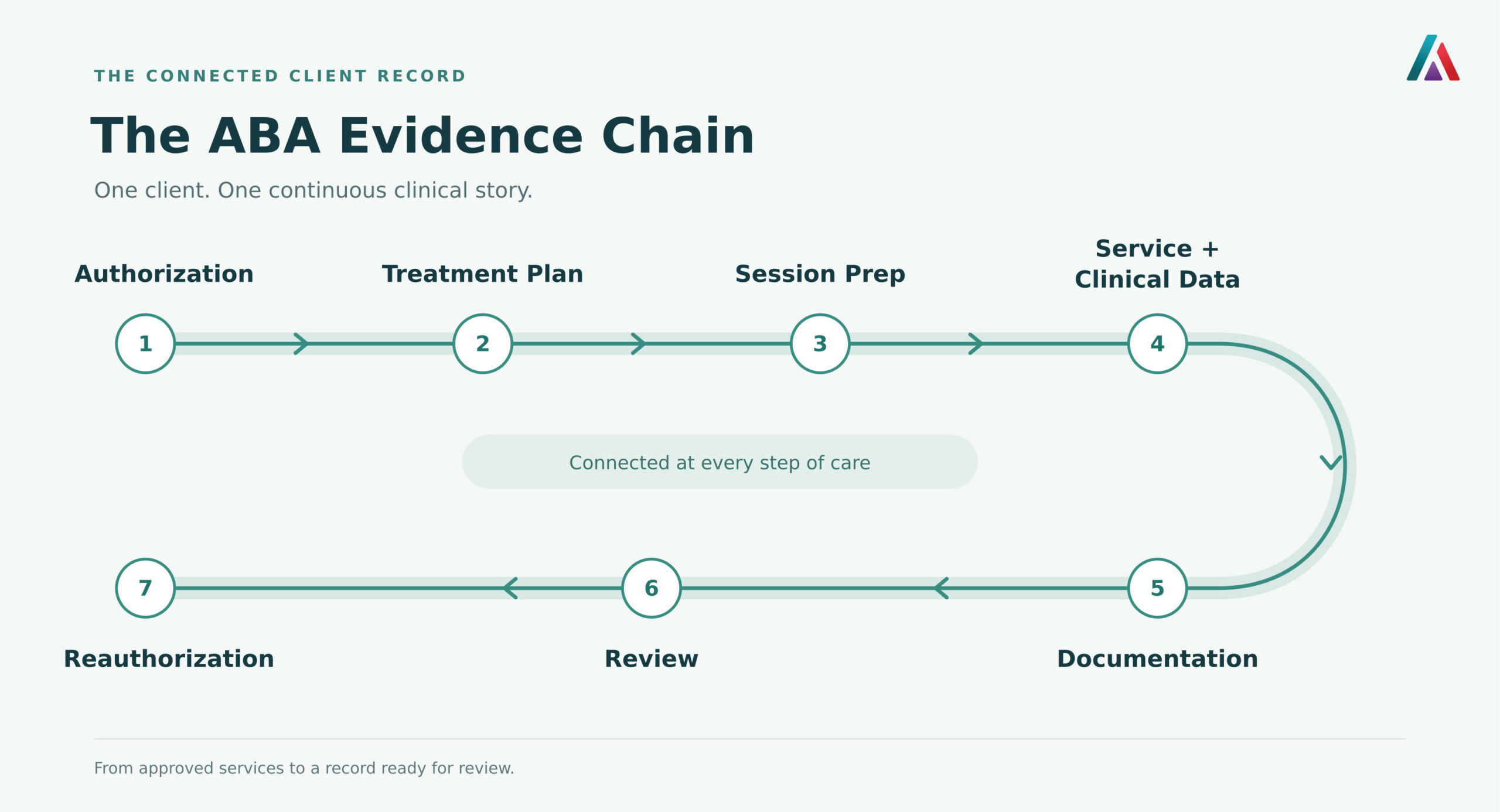
Think of the clinical and operational record behind every ABA client as a chain. Each link represents a stage in the workflow. When every link connects, the story of that client’s care can be followed from beginning to end — authorization through reauthorization — without rebuilding it from scattered sources.
When links are missing or disconnected, the chain breaks. And a broken chain is where documentation problems, authorization gaps, and audit vulnerabilities actually originate.
Here is what a complete ABA evidence chain looks like:
→ Stage 1: Authorization What services were approved, for which client, at what intensity, and for how long? How much of the authorized amount has been utilized to date? Is the team aware when a client is approaching their authorized limit — before the authorization lapses?
→ Stage 2: Clinical Plan What is the BCBA trying to change and how? What assessment data informed the goals? How is the treatment program structured, and how does it connect to the documented medical necessity for the authorized services?
→ Stage 3: Session Preparation Does the direct care provider — the RBT or BT arriving at the session — have access to the BCBA’s current programming? Is the clinical plan they’re executing the one the BCBA actually wrote, or an older version that never got updated in the field?
→ Stage 4: Service Delivery and Data Collection What actually happened in the session? What targets were run, what data were collected, what behaviors occurred? This is the raw clinical record — and it needs to exist in a form that connects directly to the treatment plan, not as a parallel artifact that has to be reconciled later.
→ Stage 5: Session Documentation Does the session note reflect what the data show? Does it describe the specific interventions used — not just the general session — in enough detail to support the CPT code billed and the payer’s current documentation expectations? UnitedHealthcare and Anthem BCBS both tightened ABA session note requirements in late 2025, requiring specific intervention descriptions rather than general session summaries.
→ Stage 6: Clinical Review and Supervision Can the BCBA review session data, monitor progress, and make programming adjustments without manually compiling records from multiple sources? Is supervision documented in a way that connects to the services delivered and the provider who delivered them?
→ Stage 7: Reauthorization When the reauthorization deadline approaches, can the clinical and operations team assemble the case — progress data, treatment plan updates, utilization summary, supporting documentation — from a connected record? Or does reauthorization mean rebuilding the story from scratch every single time?
Where the Chain Most Commonly Breaks
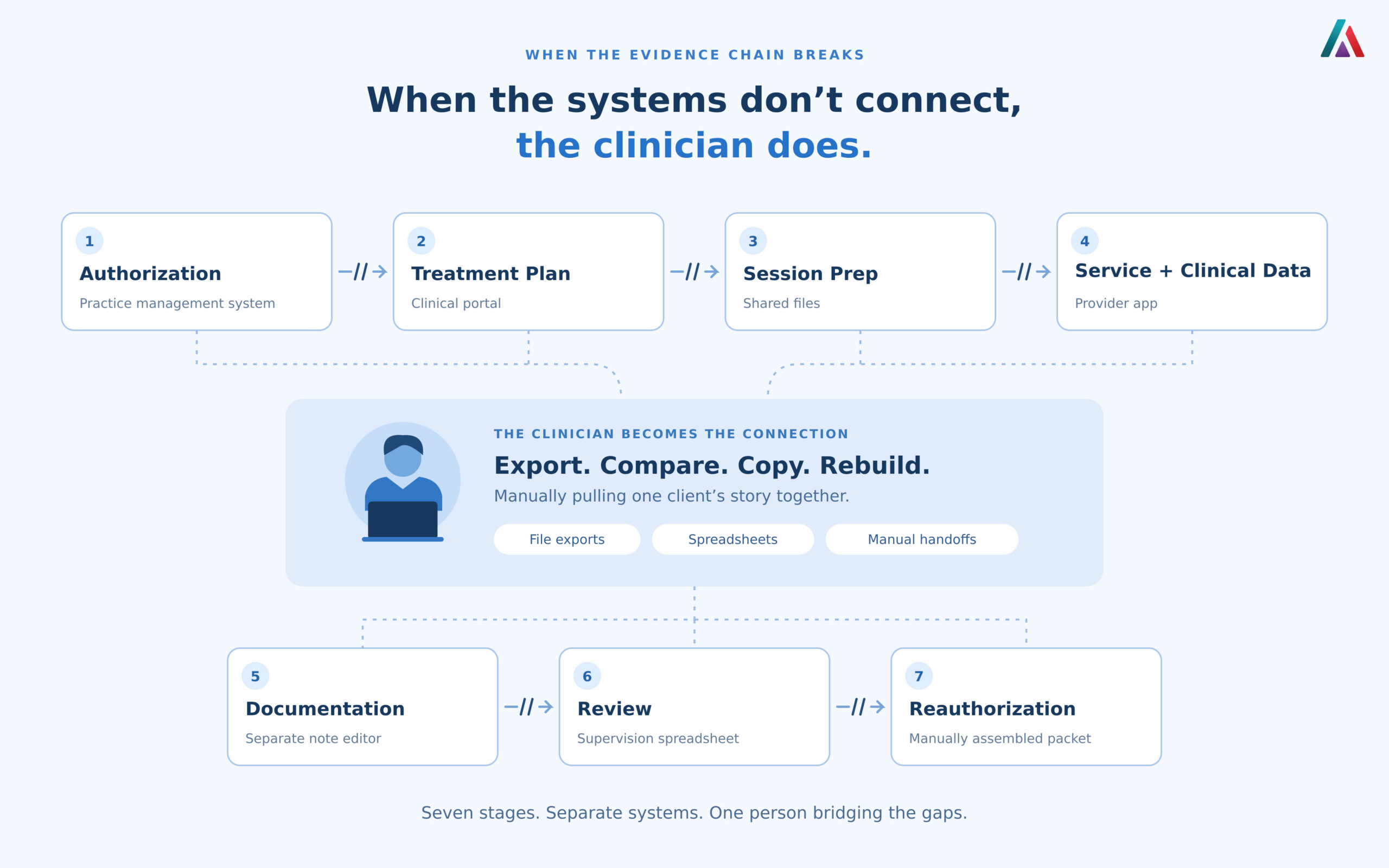
Most ABA practices are not missing data. They are missing connection between data that already exists in different places.
The authorization record lives in the practice management system. The treatment plan lives in the clinical portal. The session data lives in the mobile app. The session note is written separately, sometimes hours after the session ends. The supervision record is in a spreadsheet. The reauthorization packet is assembled manually, by someone who has to touch all of those systems in sequence.
That disconnection creates five predictable failure points:
- The plan-to-session gap. The BCBA writes a detailed treatment plan in the clinical system. The RBT arrives at the session with a version that may or may not reflect the most current programming. Clinical intent gets lost in the handoff.
- The data-to-note gap. Session data is collected on a mobile device. The session note is written in a different system, or later from memory, without direct reference to what the data actually showed. The note and the data tell different stories.
- The authorization visibility gap. The clinical team is focused on delivering services. The operations team is managing authorizations. Neither has real-time visibility into how much of the authorized amount has been used — until someone checks manually, usually reactively.
- The BCBA as human integration layer. Someone — usually the BCBA or clinical director — becomes responsible for manually reconciling plans, session data, notes, authorization context, and supervision records every time a review, audit request, or reauthorization deadline arrives. This is not clinical leadership. It is administrative overhead wearing a clinical badge.
- The reauthorization scramble. The 60-day mark arrives and the team discovers that assembling the reauthorization packet requires touching five systems, chasing down signatures, and reconstructing a clinical narrative that should have been continuously maintained.
Questions Worth Asking About Your Current Workflow
Before the next reauthorization cycle or team review, these are worth an honest internal conversation — regardless of what platform your practice uses:
Can you follow one client from initial authorization through reauthorization without opening more than one system? If the answer is no, identify specifically where the handoff breaks. That is where the chain needs to be examined.
Does your session documentation reflect what actually happened — or what was planned to happen? Payers and auditors in 2026 are specifically examining whether notes describe actual interventions or simply mirror the treatment plan. The OIG Colorado findings cited this pattern explicitly.
Can you confirm, for any given session, which provider delivered the service and at what credential level? Rendering provider mismatches are among the most common — and most avoidable — findings across every completed OIG audit.
Do you have real-time authorization visibility or does your team find out a client is near their limit reactively? Proactive utilization tracking is one of the clearest operational separators between practices that manage reauthorization smoothly and those that don’t.
If your state or a payer changed its documentation expectations tomorrow, how quickly would your clinical and operations teams know where that change touches your workflows? The speed and confidence of that answer reflects how connected — or disconnected — your clinical and operational record actually is.
What Better Technology Should Actually Do
The goal of connected ABA clinical workflow technology is not to generate more documentation. It is to reduce the distance between what happens in a session and what the record shows — so that the clinical story can be followed without rebuilding it from disconnected sources every time someone needs to look.
That means:
Authorization visibility connected to the clinical record — so the team managing services and the team managing authorizations are working from the same information, not separate systems that have to be reconciled manually.
Treatment plan continuity from planning to point of care — so the programming a BCBA writes is what the RBT executes in the session, without a manual handoff that can introduce error or version drift.
Session data that connects to documentation — so the note reflects what the data show, not what someone remembered after the session ended.
A connected record that can be reviewed, not reconstructed — so that clinical review, supervision documentation, reauthorization preparation, and audit response draw from one source rather than requiring someone to bridge multiple systems manually.
Where ATrack Fits
ATrack is built around this problem. The platform connects clinical and operational ABA workflows through a shared client record — from authorization management and clinical planning in the BCBA portal, through point-of-care data collection and session documentation in the mobile Provider App, through operational review, reporting, and billing preparation.
The workflow is straightforward: Manage in AMP → Plan in ATP → Deliver in the Provider App → Review and act through the connected record.
This is not a compliance guarantee. No platform can guarantee audit outcomes, payer approval, or reimbursement results — and any vendor that claims otherwise should be questioned carefully. What ATrack offers is a more connected operational foundation: one where the clinical story behind each client is easier to follow, easier to review, and easier to hand off — without rebuilding it from scratch every time someone needs to look.
For practices evaluating whether their current workflows are ready for the oversight environment taking shape in 2026 and 2027, that foundation is worth examining.
One Practical Starting Point
Pick one active client. Try to follow their clinical story — from the original authorization and treatment plan through the most recent session data, documentation, and supervision record — using only the systems your team currently uses.
Note how many systems you open. Note where the story requires manual reconstruction. Note whether the session data and the session note tell the same story. Note whether the authorization utilization picture is immediately visible or requires a separate check.
That exercise will tell you more about where your evidence chain is intact — and where it breaks — than any checklist or audit framework.
For a shorter overview of the August 2026 CMS ABA Toolkit and what it means operationally, read our ABA Industry Update →

Sources
CMS. “CMS Launches New State Toolkit to Protect Children with Autism, Strengthen Oversight of Applied Behavior Analysis Services.” August 4, 2026. cms.gov
HHS-OIG. ABA Medicaid Audit Series (SRS-A-25-029). Completed audits: Colorado (February 2026), Wisconsin (December 2024), Maine (2026). oig.hhs.gov
ABA Coding Coalition. “ABA CPT Codes Update — 2027 Changes.” abacodes.org
Sources reviewed through September 2, 2026.